
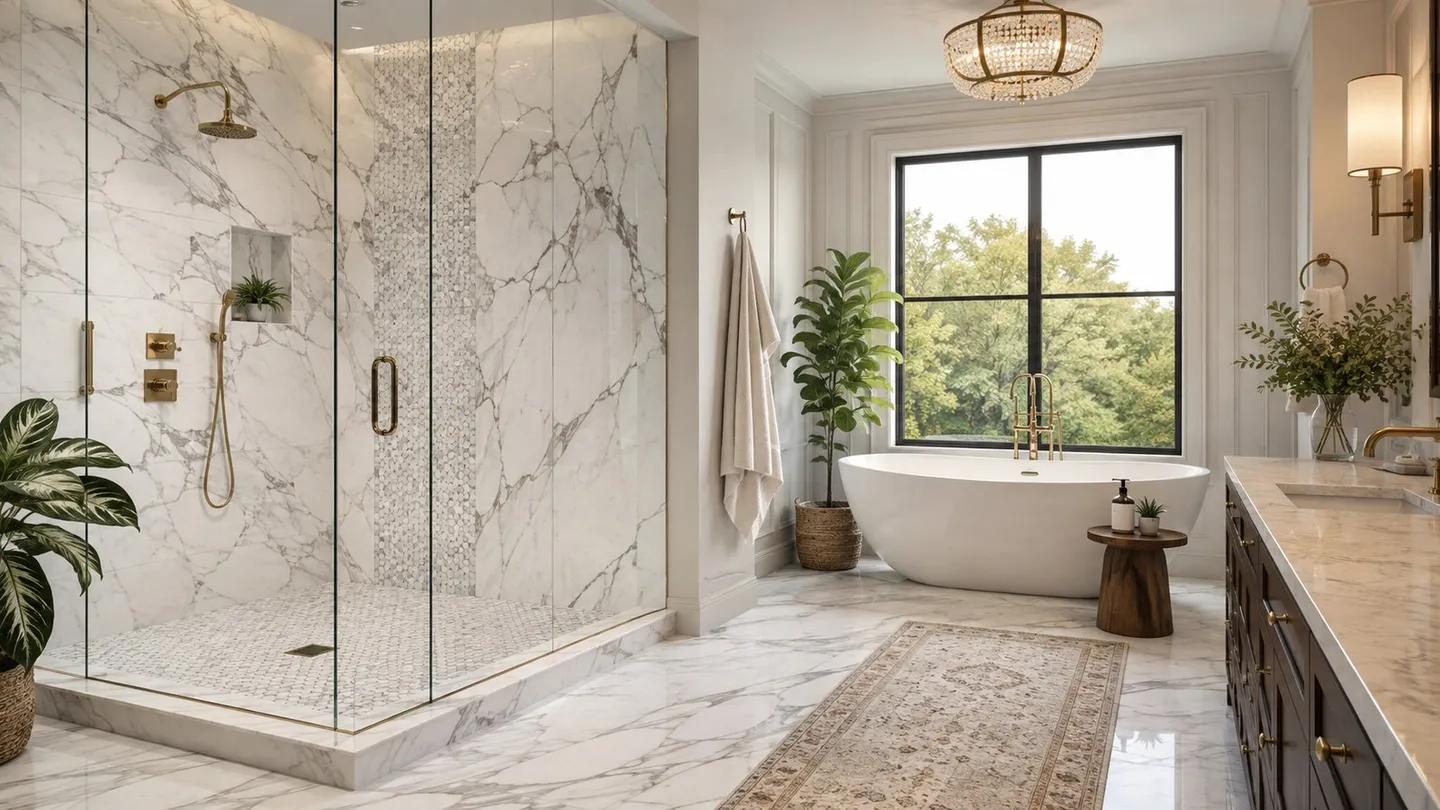
There is a particular moment during a renovation when a room stops feeling like a collection of measurements, drawings, and material samples and starts developing a personality. With natural stone, that moment often comes surprisingly early. Put a beautiful piece of Carrara, Calacatta, Bardiglio, or Thassos marble on a countertop and suddenly you can imagine the finished bathroom, kitchen, entryway, or shower.
That emotional response matters. But it should not be the only reason for choosing marble.
When searching for marble tile for sale, homeowners and designers have to balance appearance with finish, format, installation requirements, natural variation, maintenance, budget, and the practical demands of the room. A dramatic polished stone that looks spectacular on a feature wall may not necessarily be the first choice for a frequently wet floor. Likewise, a subtle honed marble that appears understated in a sample can become exceptional once installed across a larger surface.
This is why buying marble deserves more thought than simply choosing "white," "gray," or "beige."
Surfaces Galore offers a broad natural-stone selection that illustrates just how diverse marble can be, including Carrara White, Calacatta Gold, Bardiglio, Bianco Dolomite, Thassos White, Nero Marquina, Crema Marfil, Emperador Dark, Statuary marble, Ming Green, Rosso Levanto, Calacatta Viola and numerous other distinctive stones. Tiles, mosaics, checkerboard designs and custom patterns provide additional possibilities for creating a space that feels genuinely individual.
So, where should you begin?
Why Marble Still Feels Different From Manufactured Tile
Marble does something that manufactured surfaces spend considerable effort trying to imitate: it varies naturally.
Veining moves. Background shades change. One tile may contain a quiet gray line while the next has a stronger mineral pattern. Even pieces cut from the same type of stone will not be perfectly identical.
For some buyers, this creates uncertainty.
"I want to know exactly what my floor is going to look like."
That is understandable, especially when ordering material for a major renovation. Yet complete visual uniformity would remove one of marble's defining characteristics. Natural variation is not simply an inconvenience that must be tolerated. It is part of the design.
Consider Carrara White. Its soft white-to-gray background and restrained gray veining make it adaptable to many interiors. Calacatta Gold can create a noticeably more dramatic impression, combining a creamy white base with stronger veining and warmer gold tones. Bardiglio moves toward deeper gray shades. Nero Marquina introduces an entirely different mood with its dark appearance.
Choosing between them is not merely a matter of quality. It is a question of atmosphere.
A bright bathroom with white cabinetry and large windows might benefit from Carrara's subtle movement. A master bathroom intended to become a visual centerpiece could justify the stronger personality of Calacatta. Meanwhile, dark marble can add contrast to a bar, powder room, fireplace surround, or sophisticated entryway.
The important lesson is simple: do not shop for marble as though every stone is interchangeable.
What to Consider When Looking at Marble Tile for Sale
Price naturally receives attention, but a price-per-square-foot comparison does not tell the whole story.
When evaluating marble tile for sale, consider at least five practical factors: the stone itself, format, finish, intended location and consistency with the rest of the design.
Start With the Room, Not the Tile
This sounds obvious, yet it is one of the easiest mistakes to make.
You find an extraordinary tile and immediately start imagining where it could go. A better process works in the opposite direction.
Ask what the room needs first.
Is it a small powder room where a bold pattern could become the main attraction? Is it a large kitchen where too much veining might compete with cabinetry and countertops? Are you designing a shower that needs visual texture without becoming overwhelming? Does the room receive plenty of daylight, or does it depend largely on artificial lighting?
A marble selection should answer those questions.
For example, imagine a compact guest bathroom measuring roughly 50 square feet. Covering every visible surface in highly dramatic veined stone could make the room visually busy. Instead, a designer might use understated rectangular marble tiles on the walls and introduce a more detailed marble mosaic tile in the shower niche or floor.
The material remains consistent while the scale changes.
That is a small decision with a big effect.
Polished or Honed Marble?
Finish dramatically changes how natural stone behaves visually.
Surfaces Galore carries marble products in finishes including polished and honed, while its wider natural-stone range also includes brushed, textured, tumbled and split-face options.
Polished Marble
Polishing creates a reflective surface that emphasizes color and veining. Light moves across it beautifully, which is one reason polished marble can look so striking on walls and decorative surfaces.
It tends to feel formal and crisp.
The downside? A highly reflective finish can make scratches, etching, water marks and other imperfections easier to notice under certain lighting conditions. The suitability of a polished finish also needs to be considered carefully for wet flooring applications.
Honed Marble
Honed stone has a softer, more matte appearance.
It often works particularly well when the goal is understated luxury rather than shine. Veining remains visible, but reflections are reduced. In many contemporary interiors, this gives marble a relaxed architectural quality.
There is no universally superior finish.
The right finish is the one that suits the application and the way you expect the surface to age.
If someone says, "I want the marble to stay absolutely perfect forever," natural stone may require an adjustment in expectations. Marble is a real geological material. It develops character through use, and its maintenance requirements are different from those of porcelain.
For many homeowners, that is precisely part of its appeal.
Marble Tile for Sale in Different Colors and Personalities
One of the biggest misconceptions about marble is that it means white stone with gray veins.
That is only one chapter of the story.
Carrara White: Quiet and Adaptable
Carrara White is an enduring choice because it is relatively easy to integrate with different styles. Soft gray veining allows it to work with painted cabinetry, wood, metal, glass and many neutral palettes.
It can feel traditional in one setting and surprisingly contemporary in another.
Use simple rectangular Carrara tiles with restrained grout lines and modern fittings, and the effect can be clean and architectural. Put the same stone into a classic mosaic format alongside traditional fixtures and it immediately takes on another personality.
Calacatta Gold: When Veining Becomes Part of the Design
Calacatta Gold is not a background material in the same way.
Its creamy white base and pronounced gray-to-gold veining naturally draw attention. That makes it particularly interesting for spaces where stone should become a focal point.
Think shower walls, feature floors, statement bathrooms or carefully planned backsplashes.
The compromise is that stronger veining requires more attention during layout. Random placement can produce awkward transitions. Before installation, laying pieces out and considering how the veins relate to one another can dramatically improve the final result.
Installation is not merely technical. With expressive marble, it becomes part of the design process.
Bardiglio: A Richer Gray Alternative
For interiors where bright white feels too predictable, Bardiglio introduces depth.
Gray marble can create a sophisticated transition between light and dark materials. It works especially well with white stone, which is why combinations of Carrara and Bardiglio can create attractive checkerboard and geometric effects.
It is also useful when designers want natural variation without committing to the strong contrast of black marble.
Thassos White: Bright and Precise
Thassos White marble is known for its clean, luminous appearance. Surfaces Galore offers the material in multiple formats, including mosaic designs.
This type of stone is particularly useful when brightness itself is part of the concept. A small bathroom, for example, can benefit from a lighter material palette, while mosaic formats can introduce detail without adding multiple competing colors.
Marble Beyond Neutral Colors
Then there are stones that challenge the conventional idea of marble completely.
Ming Green introduces gentle green tones. Rosso Levanto offers rich reddish coloring. Calacatta Viola brings deep violet veining across a lighter background. Emperador varieties move into brown tones, while Nero Marquina provides dramatic darkness.
These materials require confidence.
But they can also create the rooms people remember.
Why Marble Mosaic Tile Can Completely Change a Space
Large-format tiles create continuity. Mosaics create rhythm.
A marble mosaic tile breaks stone into smaller elements that can form herringbone, hexagonal, pinwheel, basketweave, octagon, checkerboard and numerous other arrangements.
That makes mosaics particularly useful when the designer wants texture without changing materials.
Imagine a shower clad primarily in rectangular white marble. The overall appearance is elegant but restrained. Now introduce a herringbone mosaic into the niche and a smaller geometric mosaic on the shower floor.
The room suddenly gains layers.
The stone has not changed dramatically. The scale has.
Surfaces Galore carries standard marble mosaics alongside custom mosaic options, making it possible to explore combinations of colors, patterns and stones rather than being limited to conventional formats.
Where Mosaics Work Especially Well
Mosaics can be effective for:
• shower floors• shower niches• kitchen backsplashes• bathroom accent walls• decorative borders• fireplace details• entryways• feature flooring• transitions between larger tiles
However, more pattern does not automatically mean better design.
A complex mosaic next to a heavily veined countertop, patterned floor and decorative cabinetry can create visual competition. If one material is supposed to be the star, the others need to give it room.
Luxury often comes from restraint.
Checkerboard Marble: Traditional Idea, Modern Possibilities
Checkerboard floors demonstrate how old design ideas can feel surprisingly fresh when materials and proportions are chosen carefully.
The principle is simple: alternating contrasting stone colors.
But the result can range from historic European elegance to modern minimalism.
A white-and-gray combination creates softer contrast. White and black becomes much more graphic. Beige and brown can produce a warmer atmosphere.
Surfaces Galore includes checkerboard collections in real marble and travertine, which provides another route for homeowners who want something more distinctive than a single-stone floor.
The size of each square matters too.
Small squares generate more visual movement. Larger squares make the pattern feel broader and calmer. In a narrow entryway, proportions can completely change how spacious the area appears.
This is where ordering samples and planning the layout before installation becomes extremely valuable.
How to Buy Marble Tiles Online Without Guessing
The ability to buy marble tiles online gives homeowners access to a much wider selection than many local showrooms can physically display.
But natural stone introduces an obvious complication: your screen is not stone.
Photography, monitor brightness, surrounding colors and lighting conditions can influence how a material appears. More importantly, marble naturally varies from piece to piece.
That does not mean online ordering is risky by definition. It means the purchasing process should account for the characteristics of the material.
Order Samples First
Surfaces Galore provides samples, which is an important step for projects where color relationships matter.
Do not simply hold a sample in your hand for thirty seconds.
Place it in the actual room.
Look at it in morning daylight. Check it again in the evening. Put it next to the cabinet door, wall paint, countertop, metal finishes and flooring.
You may be surprised.
A stone that looked warm online can appear cooler next to cream cabinetry. A subtle gray vein can suddenly become much more visible beside a pure-white bathtub.
Context changes color perception.
Calculate More Than the Exact Square Footage
If a room requires exactly 100 square feet of material, ordering exactly 100 square feet is rarely sensible.
Cuts create waste. Some pieces may be unsuitable for a particular visible location because of their natural pattern. Installation layouts also affect material consumption.
The appropriate overage depends on the tile format, room geometry and installation pattern. Straightforward layouts may require less additional material than complex diagonal, herringbone or highly customized installations.
Discuss the required quantity with the installer before ordering.
Running out near the end of the project is particularly frustrating with natural stone because a later batch can show differences in tone or veining.
The Cheapest Marble Is Not Necessarily the Best Purchase
Price comparisons are useful. They are not the complete calculation.
Natural stone varies in grading, selection and visual quality. Shipping also matters because marble is heavy and can be damaged when improperly handled.
Surfaces Galore positions its offering around premium-quality natural stone rather than cheap commercial-grade material. The company states that shipments are insured and that most orders are dispatched quickly. It also provides assistance for material selection and offers samples before a larger purchase.
These details matter because tile is only inexpensive if it reaches the project in usable condition and produces the expected result.
Suppose Supplier A offers stone for several dollars less per square foot, but the material contains greater inconsistency than expected. The installer then spends additional time sorting pieces, rejects several tiles from highly visible locations and eventually needs more material.
The original saving becomes less impressive.
Conversely, paying more does not automatically guarantee that a product is right for your room. Quality and suitability are separate questions.
The goal is to find both.
A Practical Example: Designing a Marble Bathroom
Consider a homeowner renovating a primary bathroom.
They initially search for marble tile for sale and fall in love with Calacatta Gold because of its dramatic veining. Their first idea is simple: put it everywhere.
Floor. Walls. Shower. Vanity backsplash. Niche.
This is where a designer might say, "The stone is beautiful, but give it somewhere to breathe."
A more considered plan could use larger Calacatta Gold tiles across the main shower walls, a complementary mosaic on the shower floor and a quieter surface elsewhere in the room. The same family of stone can appear in several formats, creating continuity without turning every square foot into a competing focal point.
Before ordering, samples are compared with the vanity finish and bathroom lighting. The installer calculates waste based on the layout. More material is ordered than the exact room measurement requires, allowing for cuts and selective placement of strongly veined pieces.
Before installation begins, the most expressive tiles are dry-laid on the floor.
One dramatic piece is reserved for the area visible immediately when entering the bathroom. Another is positioned behind the freestanding tub. Less distinctive pieces go into areas partly hidden by fixtures.
Same marble.
Same room.
Much better result.
That is what thoughtful natural-stone installation looks like.
Common Marble Mistakes and How to Avoid Them
Mistake 1: Expecting Every Tile to Match
Natural stone varies. If identical patterning is essential, marble may not satisfy that requirement.
Instead of fighting variation, plan for it.
Mistake 2: Choosing From a Screen Alone
Online photographs are useful for narrowing options, but samples provide a more realistic understanding of color, texture and finish.
Mistake 3: Forgetting About Grout
Grout can either emphasize individual tiles or make them visually blend together.
A contrasting grout creates stronger geometry. A closer color match produces a quieter surface. With mosaics, where grout lines are more numerous, this decision becomes particularly important.
Mistake 4: Ignoring Maintenance
Marble is calcium-based natural stone and requires appropriate care. Acidic cleaners can damage the surface, and spills should not simply be ignored.
Before installation, understand cleaning and sealing requirements for the specific material and application.
Mistake 5: Buying Too Little
Saving money by ordering the absolute minimum can become expensive if additional material is required later.
Plan waste before placing the order.
Mistake 6: Letting the Installer Choose the Layout Randomly
For heavily veined stone, tile placement can make or break the appearance.
Inspect and organize the material first.
Marble Tiles Versus Marble Mosaics
There is no need to choose one exclusively.
Standard marble tiles provide larger uninterrupted surfaces and allow the stone itself to become prominent. Mosaics emphasize pattern, geometry and detail.
They often work best together.
For instance, a kitchen backsplash could use a herringbone mosaic while a nearby floor uses larger rectangular tiles. In a bathroom, larger wall tiles can visually enlarge the space while mosaics add texture to the shower floor.
A good rule is to decide what you want people to notice first.
Stone? Pattern? Architecture?
Once you know the answer, choosing formats becomes easier.
Custom Mosaics for Projects That Need Something Different
Standard formats solve most design requirements, but occasionally the project demands something that cannot be found ready-made.
Custom mosaics offer another level of control.
Surfaces Galoreprovides custom marble and travertine mosaic possibilities that allow different stones, colors and patterns to be combined. This can be particularly interesting for entrance halls, hospitality spaces, statement bathrooms or residential projects where the floor itself becomes a decorative element.
Custom does not necessarily mean excessively complicated.
Sometimes the most successful bespoke pattern uses only two stones.
A restrained combination of white and gray marble, for example, can produce a distinctive geometric design while remaining versatile enough to coexist with furniture and architectural details.
Buying Marble Online: Convenience Should Not Replace Planning
When you buy marble tiles online, the biggest advantage is choice. You can compare stone families, sizes, mosaics, finishes and patterns without being limited to what happens to be sitting in a nearby warehouse showroom.
Use that choice carefully.
Do not rush from discovery to checkout.
Shortlist several stones. Compare their characteristics. Order samples. Look at photographs of completed installations. Confirm measurements with your installer. Decide on the finish. Consider grout. Calculate additional material. Then order.
It may feel slower at the beginning.
It is much faster than correcting a poor material decision after installation starts.
How Much Pattern Is Too Much?
This question does not have a mathematical answer.
It depends on the room.
If the kitchen already has strongly figured countertops, detailed cabinet fronts and prominent hardware, an intricate marble backsplash may push the design too far. A simpler rectangular marble tile could provide balance.
In a minimalist bathroom with flat cabinetry, simple fixtures and neutral walls, a geometric marble mosaic tile can become the detail that prevents the space from feeling sterile.
Think in terms of hierarchy.
Every room needs a first thing you notice, a second thing you notice and quieter elements supporting them.
If everything demands attention, nothing wins.
Natural Stone Is About Character, Not Perfection
Marble has survived changing interior trends because it does not depend entirely on fashion.
Carrara has been used for centuries. Checkerboard stone floors repeatedly return to contemporary interiors. Herringbone and geometric mosaics can move between traditional and modern settings simply through changes in scale, color and surrounding materials.
But natural marble is not for someone who wants every square inch to remain visually identical.
There will be variation.
There can be mineral characteristics.
The surface will need appropriate care.
And yes, choosing the right material can take longer than selecting a mass-produced ceramic tile.
Those are real compromises.
The reward is equally real: a surface created by nature rather than printed to resemble one.
Finding the Right Marble Tile for Sale
A successful search for marble tile for sale should eventually move beyond price and appearance.
Ask yourself:
• Where will the stone be installed?• How much traffic or moisture will the area experience?• Do I prefer subtle or expressive veining?• Should the finish be polished or honed?• Do I want large surfaces or detailed mosaics?• How will the stone relate to cabinetry, paint and countertops?• Have I seen a physical sample?• Has the installer calculated waste?• Do I understand maintenance requirements?• Have I planned tile placement before installation?
These questions may seem less exciting than scrolling through photographs of spectacular bathrooms.
They are also the questions that prevent expensive mistakes.
Final Recommendation: Choose Marble With Both Your Eyes and Your Head
Beautiful marble creates an immediate reaction. That matters. A home should contain materials you genuinely enjoy seeing and touching.
But the best projects combine that instinctive attraction with practical planning.
When evaluating marble tile for sale, begin with the room and its requirements. Explore stones such as Carrara White, Calacatta Gold, Bardiglio, Bianco Dolomite, Thassos, Nero Marquina and more expressive colored marbles. Compare polished and honed surfaces. Consider whether larger tiles, checkerboard layouts or mosaics best support the design.
Then get physical samples.
Live with them for a few days.
Move them around the room.
And involve the installer before calculating the final quantity.
Surfaces Galore provides a particularly broad selection for this process, ranging from classic marble tiles and intricate mosaics to checkerboard designs and custom-made patterns. For homeowners who want to buy marble tiles online, having access to multiple stone varieties, finishes and formats makes it possible to design around the project rather than simply settling for whatever happens to be locally available.
Most importantly, accept what makes natural stone natural.
The vein running through one tile may not continue perfectly into the next. A piece may contain more movement than the sample. Another may be quieter. Those differences are not necessarily flaws waiting to be corrected.
They are the reason the finished installation cannot be perfectly duplicated in somebody else's house.
And that is arguably marble's greatest strength.